skip to main |
skip to sidebar
 Date: Samedi le 16 avril 2011 de 16h30 à 20h30
Au: Mosaic Carling Buffet, 2583 Avenue Carling, Ottawa
Le souper bénéfice est une activité pour supporter le Dr. Hassan Diab, Canadien d’origine libanaise et professeur de sociologie faisant face à des procédures d’extradition injustes. L’injuste loi canadienne d’extradition permet que des Canadiens et des Canadiennes soient envoyé.es vers des pays étrangers sur la base de preuves peu solides et peu fiables qui ne sont pas acceptées par les tribunaux canadiens. Nous sommes tous et toutes concernées par la poursuite de la justice menée par le Dr. Diab.
Les billets pour le souper bénéfice sont de 20$ par personne et de 60$ par famille. Les prix incluent le buffet à volonté du Mosaic.
Les billets sont disponibles en pré-vente à Ottawa. Vous pouvez trouver un point de vente ici.
Come to a Fundraising Dinner for Hassan Diab
You are invited to a fundraising dinner in support of Hassan Diab. Click here for a flyer for the event.
When: Saturday, April 16, 2011, 4:30 PM – 8:30 PM
Where: Mosaic Carling Buffet, 2583 Carling Avenue, Ottawa
Dinner tickets are $20 per person or $60 per family. This includes Mosaic’s ALL YOU CAN EAT BUFFET.
You can purchase fundraising dinner tickets in three ways:- Send e-money transfer, $20 for each single ticket or $60 for a family pass, to diabsupport@gmail.com. Include your name with the money transfer. Your tickets will be available for pickup at the event.
- Or visit one of the following stores to purchase tickets directly:
- New Middle East Supermarket, 1755 Bank St, Ottawa, Tel (613) 526-3423
- Al Sham Food and Meat Market, 4000 Bridal Path, Ottawa, Tel (613) 745-2477
- Sultan Supermarket, 2446 Bank St., Ottawa, Tel (613) 736-1600
- Guardian / Hunt Club Pharmacy (Contact: Solly Saloojee), 2430 Bank St, Ottawa, Tel (613) 521-7955
- Malak Pastry (Contact: Abou-Rabeih), 1216 Bank St, Ottawa, Tel (613) 526-2002
- Aladdin Bakery (Contact: Samera Ghadban-Farhat), 1801 Carling Ave., Ottawa, Tel (613) 728-5331
- Damas Supermarket, 3033 Carling Ave, Ottawa, Tel (613) 726-1792
- Or call (613) 686-5599, and make arrangements for ticket pickup.
CUPW Letter to the Canadian Minister of Justice
 The Canadian Union of Postal Workers wrote a letter to the Canadian Minister of Justice, Mr. Robert Nicholson, concerning Dr. Hassan Diab’s extradition case.
http://www.justiceforhassandiab.org/wp-content/uploads/2011/03/CUPW_to_Nicholson_Mar2011.pdf
“... Recently, the court refused to exclude “very problematic” and “very confusing” handwriting evidence against Dr. Diab, saying that Canadian standards of evidence do not apply in an extradition case.
The court also refused to admit finger and palm print evidence. The court dismissed it as “competing inference” – which is not allowed in an extradition case.
CUPW believes that in any extradition case, the court must ensure there is sufficient and reliable evidence to support the request...”
“A complete railroad job”
By Rachel Anjorin Amidst all the legal hullaballoo of the Hassan Diab case, something critical keeps fading out of view. Simply put: Hassan is innocent, as proven by French investigators’ own case documents and palm print and finger print mismatches -- and they know this but don’t want to accept it.
So, why do French investigators pursue Hassan when they know he is innocent? We can speculate about possible political ambition, tunnel vision, fear of embarrassment, and the desire to score “hero points”.
However, what really matters is what happens to the innocent man caught up in this runaway legal process.
The judge can decide to (1) extradite Hassan, (2) refuse to extradite Hassan, or (3) stay the entire proceedings.
Option 1 involves sending an innocent man to an unfair trial in France, under an inquisitorial (or shall we say “inquisitional”?) system whereby he cannot bring his own witnesses and cannot challenge the sources of secret intelligence.
Option 2 amounts to a decision that there is not enough evidence for extradition. While this is true, this is a decision that doesn’t begin to address the real horrors in this case under this body of extradition law and a legal process that has seen suppression of exonerating evidence and falsehoods entered into the Record of the Case as “presumptively reliable”. This option would fail to provide redress for the abusive prosecution of a man known to be innocent, costing him his freedom, livelihood, and years of his life. This option would not prevent French investigators from restarting the entire extradition process.
Option 3 would be to stay (halt) the entire case, ending the matter once and for all, and recognizing the wrongdoing French investigators have committed against Hassan and against the Canadian court. Real and authentic justice would require the judge to acknowledge that France has abused the Canadian legal process.
In sum, the options are:
- Option 1: Committal for extradition leading to almost certain conviction in a kangaroo court followed by life in prison
- Option 2: Abstaining from a definitive decision either way
- Option 3: Authentic justice
French investigators insist that the judge accept the Record of the Case as originally put forth in 2008, and ignore all the significant evidence that has come to light since then. The French stance amounts to saying, “In the extradition treaty, you promised to accept whatever we say as reliable; so we insist that you do so, in spite of all the evidence to the contrary. You’re bound by treaty to accept our theory, as improbable as it may be in view of the facts. While you may have caught us lying about some things, you have to believe us anyway. After all, you promised!”
Hassan’s lawyer presented nine abuses of process (selected from a larger number) perpetrated by French investigators in this case. These are deliberate misrepresentations and omissions that were used together with secret intelligence and bogus handwriting analysis to fabricate the case against Hassan.
In an adversarial legal system, the prosecutor is supposed to marshal all the evidence against the accused and leverage this evidence for all it’s worth to get a conviction. But in an adversarial system, the accused also has the defence to marshal exonerating evidence, and to counterbalance the prosecutor. Each side must address the points made by the other side, so everyone has the same opportunity for influence on the outcome of the case.
Extradition law has none of this balance. The accused is severely disadvantaged, while the prosecutor representing the requesting state needs to prove almost nothing in order to achieve extradition.
That’s why it’s so crucial to have an honest Record of the Case for an extradition hearing. The Record of the Case must be scrupulously fair, candid and representative of all the evidence in the case. This is the only way to ensure a modicum of balance and fairness when someone may be deprived of his liberty.
In this extradition process, French investigators want to have their cake and eat it too. They want to enjoy the presumptive reliability accorded by treaty while suppressing exonerating evidence, cherry-picking evidence, contradicting themselves, and stretching and spinning the evidence in very misleading ways. They also want Candians extradited to their country, while they would never extradite their own citizens. If they are allowed to get away with this, then Hassan Diab’s case will be a complete railroad job. And it will mean any Canadian is a sitting duck whenever any of Canada’s extradition partners is looking for a scapegoat with whom to close a case.
A decision to stay the extradition proceedings would be the only truly just option in this case, and it would have to be based on the nine abuses identified by the defence.
As to the insistence of French investigators on continued trust, I say:
Fool me once, shame on you.
Fool me twice, shame on me.
Fool me 9 times? OUTRIGHT ABUSE.
My Kafkaesque Justice
 By Rania Tfaily
The following is a presentation by Dr. Rania Tfaily, Hassan Diab's partner, which she delivered at an event, entitled “Kafkaesque Justice: The Case of Hassan Diab”, organized by the Communications, Energy, and Paperworkers (CEP) Union of Canada, Local 2025, on February 7, 2011.
In her presentation, Rania describes the Kafkaesque atmosphere that Hassan has been subjected to, since he was falsely accused by French authorities of involvement in a bombing in Paris in 1980.
Special thanks to CEP Local 2025 for organizing the event.
“I would like to share a story with you...
Imagine that one day out of the blue you are approached by a journalist who informs you that you are under investigation for a crime that took place about 30 years ago, and that a foreign country will be seeking your extradition from Canada. Despite your insistence that you are innocent and you are willing to answer any questions within Canada’s legal framework, you see your name and reputation tarnished overnight. Life becomes difficult with media camping out outside your work place and some threatening to follow you everywhere, including your residence. Your life is turned upside down even though you are not yet charged with any wrongdoing. You know that life will be even more difficult if a legal proceeding is started against you, but you persist in continuing your life as usual because you know that you are innocent and you believe that Canada is a country of law. Despite post 9/11 political atmosphere, you still assume that the rights of individuals against unfounded allegations and suspicions are protected.
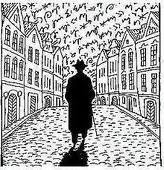 But you soon realize that something very bizarre is going on. You are being followed in an aggressive and intimidating way by people in cars with tinted windows. Unidentified people appear out of nowhere and start taking photos of you in an aggressive manner. Someone attempts to break into your home. You report all of this (along with license plate numbers) to the Ottawa Police because you naively think that the police are there to help you. But your requests for help are ignored. In a country of law, you are intimidated and harassed and you have no one to turn to.
After more than a year of this intimidation and harrassment, you are arrested. You spend the first month in solitary confinement locked up in a tiny cell all day long except for 15 minutes. You have no access to any reading materials and any books sent to you are confiscated. You get to taste what life is like inside a Canadian detention centre. You are often hungry because food is insufficient. You are cold because there are not enough blankets. You cough continuously because of the terrible recycled air. You are transported handcuffed and shackled to the court where you are sometimes left for long hours with no food or water. When you are moved to supposedly “protective custody”, you discover that bloody and disturbing physical violence are rampant. You and so many others live in these conditions even though you are presumed to be innocent.
You spend over four months in detention. After an unusual six-day bail hearing along with the testimonies of five sureties and character letters from numerous academics, you are released on bail under very strict conditions which include being allowed to leave your residence only if accompanied by a surety and that you pay for a GPS monitoring system which costs around $2,000 per month. You find work doing what you have been doing for about 20 years, but you are fired after a few classes due to political pressure. Your bank account is closed. You wonder how you are supposed to pay your bills—including legal bills—and defend yourself if you are prevented from earning an income. You wonder what it means to be presumed innocent if you are already treated as if you have been convicted.
You soldier on relying on the help of family and friends who believe in your innocence and/or want to ensure that due process is respected in Canada. You begin to learn more about the case against you. You know from one of the Crown Attorneys (before he flip-flopped on this issue) that the case against you is based on information, hypotheses, and analyses that the French intelligence service received in 1999. You have no idea how this information came about. You have no idea who said what and under what circumstances. You wonder how hypotheses and analyses become evidence in a court of law. You keep on hearing the Crown prosecutors saying that anything goes because this is an extradition. You wonder whether your government is taking the position that as a Canadian citizen you have no rights to due process because a foreign country is requesting your extradition.
 You later learn that no one involved in your case knows the source or even the reliability of the intelligence against you: not the Crown prosecutors, nor the Canadian judge, and not even the French investigators themselves, as they admit in court documents. You wonder how this can be used as “evidence” against you. It is not as if the French investigators or the Canadian government know the nature and the source of the intelligence against you but are refusing to disclose it. They simply have no idea how it came about. You wonder how you can defend yourself in these circumstances.
You also learn that there is handwriting evidence against you. Handwritten documents from your university and immigration files were compared to five words on a hotel registration card that are believed to have been written by the suspect. One French handwriting analyst says that you could be the writer; the other analyst says you are the writer. You have no doubt that this “evidence” against you is fabricated. You know this not only because you did not fill in the hotel registration card, but also because documents used in the handwriting analysis and presumed to be written by you were actually written by your ex-wife. However, you learn that proving this is not a simple matter. First, the handwriting analysis submitted by the requesting state is presumed reliable, so the burden is on you to prove that it is unreliable. Second, you do not have an automatic right to call experts to testify on your behalf. Rather, you have to apply to the court first and convince the judge that your evidence is so overwhelming that it can render the case against you wholly unreliable.
Your lawyer (Don Bayne) puts forward four esteemed handwriting experts who file detailed reports with the Court asserting that the handwriting evidence against you is rubbish. After a week of arguments in which the Crown prosecutors pleads with the judge not to allow you to call these experts, you win this right. You think that finally you will be able to expose this bogus evidence against you. But you soon learn that the extradition law gives enormous power to the requesting state – power that investigators in Canada do not have. Soon after the decision, the Crown attorneys request a lengthy adjournment of your extradition hearing, which is now postponed for six months. In the meantime, you live under strict conditions and you have to pay about $2,000 each month. Your application to alleviate your bail conditions so that you no longer have to pay the hefty cost of the GPS monitoring device is rejected.
After several months and just before your re-scheduled extradition hearing is about to start, you learn that the French investigators and the Crown attorneys are withdrawing the two initial handwriting reports against you and they are filing a new report. You learn not only that you have to start the process of challenging this “new” handwriting opinion all over again, but also that the Crown attorneys are pleading with the judge not to allow you to do so. You file an abuse of process application arguing that the manner in which the handwriting analysis was handled reflects bad faith on the part of the French investigators, but the judge dismisses your application. In the meantime, you and your lawyer start going over stacks of documents that were filed as part of the request to have your residence and work place searched. To your shock, you discover that not only evidence that is helpful to you has been suppressed from the Court in Canada, but also that other evidence and the intelligence have been manipulated.
You also learn that the French investigators knew shortly after your arrest that your palm prints do not match those left on the car used by the suspect. The French investigators never disclosed this negative result to you or to your lawyer. You also learn that the French investigators knew more than a year ago that your finger prints do not match those left by the suspect. Again this was never disclosed to you or to the Court. As one of the Crown Attorneys claimed, they are under no obligation to disclose such evidence. You also learn that the French investigators have been interviewing many people who know you, but this evidence is not presented to the Court in Canada because it is helpful to you. Anything that cast you in a positive light or is helpful to your defense is suppressed.
 Your lawyer presents the above information to the Court along with reports from three esteemed handwriting experts who rip the “new” handwriting evidence against you apart. The Crown Attorneys again fight tooth and nail to prevent you from calling this evidence. You win the right to do so. But again, your defense is limited to showing that the handwriting report filed by the French authorities is unreliable. You are prevented from calling experts who demonstrate that you did not fill in the hotel registration card and thus clear you.
You sit through three weeks of powerful testimonies of leading experts in the field of handwriting who testify how appallingly unreliable and biased the “evidence” against you is. You know that any objective person who has heard the testimonies of these experts would conclude that a scientific handwriting analysis would actually show your innocence.
While you wait for the final decision, you wonder whether the case against you would still have continued had Canada’s extradition law been fair and just. When you reflect on your experience, you wonder whether the case against you would have proceeded if it were not for the post 9/11 political atmosphere. When you hear the Crown prosecutors insist on using rubbish handwriting analysis opinion against you, you wonder what the Canadian government and the Department of Justice do with the recommendations of the inquires into the wrongfully convicted that were set up with the specific intention of preventing future miscarriages of justice.
While you wait, you know that your life has changed forever and that you will never get back what you lost. You hope that in the end fairness, reason, rationality, and justice will prevail...”
POSTSCRIPT: On Friday February 18, the judge in Hassan’s extradition hearing stunned a packed courtroom when he decided that he will use the French handwriting analysis as evidence against Hassan, despite the fact that he finds the analysis “very problematic, very confusing, with conclusions that are suspect”.
The judge likened handwriting analysis to “pseudo-science” and found merit in the defense argument that the flawed methodology used in the handwriting analysis “results in manifestly unreliable conclusions”, but said it would violate the Extradition Act if he imposed Canadian standards of evidence admissibility on foreign evidence.
Canadian Extradition and Secret Trials
Check out a report on Dr. Hassan Diab’s extradition case by Lia Tarachansky of The Real News Network.
“Canada is in a position where it always wants to kowtow to larger or more established nations. So it becomes a question not will we jump but how high will we jump, and how much do we have to bend over backwards to accommodate. In fact, never in the history of Canada have we prosecuted in Canada rather than sending people back to face prosecution in a foreign country.”
- Gary Botting, Canadian lawyer and extradition specialist
Kafkaesque Justice: An Event for Hassan Diab
Come to an event organized by Communications, Energy, and Paper Workers (CEP) Union of Canada Local 2025
When: Monday, February 7, 2011 7:00 PM
Where: PSAC Building, 233 Gilmour Street at Metcalfe, Ottawa
Should another country have the right to forcibly remove you from Canada on the basis of secret allegations?
What would it be like:- to suddenly be told by a foreign country you committed a crime 30 years ago
- to face allegations based on secret intelligence, misrepresentations, incompetent handwriting analysis, and suppressed proof of innocence
Learn about Hassan Diab's case from:- Rania Tfaily, wife of Hassan Diab
- Matthew Behrens, Coordinator of the Campaign to Stop Secret Trials
- Moderator: Peter Gose, Chair of the. Department of Sociology and Anthropology, Carleton University
Check out the poster for more details.
A Conclusion in Search of Facts
By Rachel Anjorin This essay details numerous instances in which French investigators have spared no effort to pin the 1980 Rue Copernic attack on Dr. Hassan Diab, no matter how much evidence they find showing he is an innocent man. Rather than let the facts of the case lead them to a logical conclusion, French investigators have cherry picked information, ignored a wealth of evidence that points away from Hassan as a suspect, and even changed their theory of the crime to fit a preconceived conclusion.
Modifying the Suspect's Profile. The French investigation regarding the 1980 Rue Copernic attack was leaked to the media in October 2007. A French journalist approached Dr. Diab to inform him about the pending allegations against him. The journalist inquired repeatedly whether Hassan is a Palestinian. When Hassan, who is a Lebanese, insisted he is not, the reporter expressed surprise as the investigation files, to which the reporter had been given access, have identified Hassan as a Palestinian.
The fact that Hassan is not Palestinian should have alerted French investigators to the fact that he's not the man they think he is. Instead, French investigators chose to modify the suspect's profile to match their target. The misidentification of Hassan as Palestinian was so deep-seated that it continued to be widely reported in the media for more than two years after Hassan’s encounter with the French journalist. In the official case against Hassan, the French investigators changed their description of the Rue Copernic hit team so that it reads that a group of five Palestinians had participated in the attack and that one of these men was a Lebanese.
 Mix-and-match Suspect Features. Descriptions of the Rue Copernic suspect vary tremendously regarding every feature, from age (20 to 45 years), build (very thin to rather stocky), ethnicity (European to Arab), hair length (long, medium, short) and hair color (blond, brown, black) to the presence or absence of facial hair, glasses, and so on. The wide variation in the descriptions of the suspect should be enough to discredit them, since any subset of these characteristics can be matched to a large portion of the general population. Apparently, French investigators are at liberty to mix and match features from these varied descriptions to fit their preferred suspect.
Scribbling Scandalously Mishandled. France has as evidence five block letter style words printed on a hotel registration card in Paris purportedly by the bomber himself. Investigators compared those words to samples of Hassan’s handwriting while a student at Syracuse University. Two French handwriting analysts claimed a match between the samples and the hotel registration card. Unbeknownst to French investigators, Hassan's ex-wife had done much of the writing on the samples. Remarkably, only one of the French analysts noticed the two writing styles, which look very different. In a breathtaking departure from reason, the analyst concluded that Hassan is masterfully skilled at changing his writing style. Both French handwriting analysts found a match where it was impossible to find one, thereby entirely undermining their own credibility. Once the defense pointed out these appalling flaws in the French handwriting reports, French investigators reacted by delaying court proceedings for more than five months, further prolonging Hassan’s state of house arrest. Eventually, the two handwriting reports were withdrawn in their entirety and a “fresh” handwriting report was submitted. This “new” report is expected to fare no better than the first two. (Attend court in December 2010, to learn more about this.)
Militant Mannequin. French investigators assert that Hassan bears a “strong resemblance” to sketches of the suspected bomber. The three sketches, built up from widely varying descriptions of the suspect, are generic, “modal” images of the same face made up in three different “costumes” (hair, moustache, etc.). The images are so unremarkable and common that they look like a mannequin dressed up in a variety of wigs. This is what happens when a large variety of perceptions (as in the witness descriptions) are blended. You end up with a muddy composite. The mere assertion that the sketches bear a resemblance to Hassan appears to be powerful “evidence” for French investigators, despite the fact that the sketches do not even correspond to the varied descriptions of the suspect.
Playing Games with Names. According to French investigators, the suspects in the Copernic bombing were named. This claim is based on Israeli intelligence and information from French journalists working in Beirut during the Civil War. Neither source lists Hassan as a suspect. Apparently, French investigators are free to substitute at will, inserting Hassan wherever they want to put him, and dropping other names from the list of suspects.
 Ten More Reasons Why the Case is Wrong. In addition to 24/7 GPS monitoring (which must be paid for by Hassan), curfews, and other strict bail conditions, Hassan must appear in person at the RCMP office on a weekly basis. On one of these occasions (November 2009), Hassan was detained temporarily to have his fingertip prints taken to be compared with fingertip prints found on the document signed by the suspect. A year has passed without the court being notified regarding the results. The Crown Attorneys have recently acknowledged that Hassan’s fingertip prints do not match those on the document signed by the suspect. However, they argued that the French investigators are under no obligation to disclose this exculpatory evidence. This evidence was again simply abandoned because it indicated once again that Hassan is not the guy they really want. There are likely many more examples of exonerating evidence that Hassan will never hear about, much less use in his own defense, because according to the Crown Attorneys Canada’s Extradition Law allows the requesting state to bury evidence that doesn't work out for them.
French investigators have started with a conclusion. Rather than let the facts carry them to a logical conclusion, French investigators have gone off in search of “facts” to support their conclusion. Along the way, they have ignored and omitted a great deal of inconvenient information. The French case looks very much like a conclusion in search of facts rather than the other way around. “Evidence” has been invented, derived, and backfilled when supporting facts failed to surface. It must be quite a challenge for French investigators to hold at bay the tide of evidence running counter to their preconceived conclusion. Perhaps by now they have even come to realize (subconsciously, perhaps) that they are after the wrong man.
Sadly and unfairly, the Canadian extradition process is not designed to take into account the mountain of exonerating evidence. The legal process is driven by whatever information the French investigators choose to keep within the four corners of a document known as the Record of Case. The French investigators and the Canadian Crown Attorneys representing them remain single-mindedly focused on the task of getting Hassan to France, no matter how clear it is that they are barking up the wrong tree. If French investigators had applied a fraction of the same zeal to an objective investigation, they might have apprehended the real bomber by now. This would also respect the memory of the Rue Copernic victims.
 As unfair as the Canadian extradition process is for Hassan, it pales in comparison to what he will face if extradited to France. French anti-terrorism courts have a documented track record of accepting secret intelligence as evidence, even when it is known to be the product of torture. In addition, it is most unlikely that Hassan will be granted permission by the court in France to bring his own experts to challenge the “evidence” against him or wage any meaningful defence. The privileged position the magistrate occupies within the French legal system means that once he closes the dossier and hands it to the prosecutor there are virtually no further opportunities to introduce new evidence or engage in adversarial challenge.


 Posts
Posts

